The Complete Outsourcing Checklist for UK Accounting Firms (2026 Edition)

By 2026, outsourcing has stopped being a side conversation for UK accounting firms and become a structural decision, on the same footing as hiring a manager or choosing a practice management platform. Making Tax Digital for Income Tax is now live for sole traders and landlords with qualifying income above £50,000, with the £30,000 threshold following in April 2027, and every quarter that passes brings another cohort of clients who move from one annual return to four quarterly updates. At the same time, qualified staff remain hard to hire and expensive to retain, and compliance fees sit under constant pressure from clients who can see exactly what a bookkeeping subscription costs elsewhere.
Against that backdrop, an ad-hoc approach to outsourcing - an Email introduction here, a trial project there - is not good enough for a decision this consequential. What most firms actually need is a repeatable outsourcing checklist for UK accounting firms: one a Partner can work through in a partners' meeting, attach evidence to, and defend to a regulator, an insurer, or a client who asks exactly where their data goes. That is what follows not an explainer of what outsourcing is, but a working framework for deciding whether to do it, who to do it with, and how to govern it once the contract is signed.

The seven-step framework covered in this checklist
Why UK Accounting Firms Need a Structured Outsourcing Checklist in 2026
Three forces are converging on practice capacity at once. The first is Making Tax Digital for Income Tax itself: a client who generated one self-assessment return a year now generates four quarterly updates plus a final declaration five touchpoints instead of one, without a five-fold increase in fee to match. The second is the talent market, where AAT- and ACCA-track staff remain scarce enough that firms routinely lose candidates to industry roles offering hybrid working and faster progression. The third is margin compression on compliance work generally, as clients benchmark accountancy fees against increasingly capable software. None of these forces makes outsourcing mandatory. Together, they make a documented, repeatable outsourcing checklist for UK accounting firms a governance necessity rather than a nice-to-have, because the alternative is re-litigating the same due diligence questions from scratch every time a new provider comes calling.

Making Tax Digital for Income Tax replaces one annual submission with five touchpoints a year, per client, above the mandation threshold
Step 1: Strategic Readiness: Is Outsourcing the Right Move Right Now?
Before any provider conversation starts, the honest question is internal. A firm still defining its own service lines, still deciding whether year-end work or advisory is the growth engine, is not ready to hand processes to a third party, because it has not finished deciding what those processes should look like. Readiness looks like a firm that already knows which services it wants to keep growing typically advisory, complex tax planning, and client relationship management and which services are consuming disproportionate partner and manager time relative to their fee, typically transactional bookkeeping, routine VAT, and payroll. If leadership cannot name, in one sentence each, which functions are strategic and which are operational, the next step is an internal capacity review, not a vendor shortlist.
Step 2: Function-by-Function Suitability
Not every function belongs on the same side of the outsourcing decision and treating them identically is the most common reason transitions stall. The table below sets out a starting position for eight core functions. Individual firms will adjust it for client complexity and existing systems, but it is a defensible starting point for a partners' discussion.
Accounting Function | Suitability | Why | Retain In-House |
Transaction Processing & Bookkeeping | High | High-volume, standardised, software-driven | Exception review, client queries |
VAT Return Preparation | High | Rules-based and cyclical each quarter | Final review and submission sign-off |
Payroll Processing | High | Deadline-driven, compliance-heavy | Client-facing HR queries |
Quarterly MTD ITSA Submissions | High | Repetitive and volume-scaling under MTD | Client communication on liabilities |
Management Accounts Preparation | Medium | Structured, but needs business context | Commentary and interpretation |
Year-End Statutory Accounts | Medium | Technical, but fully reviewable | Final sign-off, judgement areas |
Corporate & Personal Tax Compliance | Selective | Preparation yes, planning stays in-house | Tax position judgement, HMRC correspondence |
Advisory & Client Strategy | Retain | Relationship-dependent, judgement-led | Effectively everything |
Read the table as a heat map, not a rulebook. The functions rated ‘High’ are where firms working through an outsourcing checklist for UK accounting firms tend to see the fastest, clearest return, while the functions rated ‘Selective’ or ‘Retain’ are where a supervising manager should stay in the loop indefinitely, not as a transitional measure.
Step 3: Vendor Due Diligence
Once a firm knows what it wants to outsource, the harder discipline is qualifying who it hands that work to. Professional body guidance, including from ICAEW and ACCA, is consistent on one point: outsourcing work does not outsource professional responsibility. The engagement partner remains accountable for the work product, which means due diligence on a provider is a professional conduct obligation, not a procurement exercise. The checklist below is the minimum evidence pack a firm should be able to produce if a regulator, insurer, or client ever asks how a provider was chosen.
Category | What to Verify | Evidence to Request |
Information Security | An independently certified security management system | Current ISO 27001 certificate and scope statement |
Quality Management | Documented, audited quality processes | ISO 9001 certificate or equivalent audit report |
Professional Standing | Recognised employer or training status with a UK body | ACCA Approved Employer confirmation or equivalent |
Data Residency & Transfers | A lawful basis for any cross-border data transfer | Signed International Data Transfer Agreement or Addendum |
Business Continuity | A documented disaster recovery and failover plan | BCP/DR policy and date of last test |
Professional Indemnity | Insurance cover adequate for the work performed | Insurance certificate with cover limits |
Technology Fit | Compatibility with your practice and accounting software | Supported platform list: Xero, QuickBooks, Sage, IRIS |
References | Verifiable experience with similarly sized UK firms | Two or more references you can contact directly |
A provider that cannot produce evidence against every row without delay is not automatically disqualified, but it is a provider whose first contract should carry tighter service levels and a shorter initial term while the gaps close.
Step 4: Modelling the Economics
The financial case for outsourcing is usually made on an hourly rate comparison, and that comparison is real, but on its own it understates the effect of Making Tax Digital for Income Tax. A fully loaded UK bookkeeper or semi-senior, once salary, National Insurance, pension, software seats, and office overhead are included, typically costs several times an equivalent outsourced hour. Multiply that differential across a client base whose quarterly submission volume has just increased under MTD, and the decision stops being about headcount and starts being about whether the firm can staff quarterly-cadence work at all without either outsourcing it or raising fees to a level clients will not accept.
Running the numbers through an outsourcing checklist for UK accounting firms is what turns this from a gut call into a modelled one. A simple breakeven calculation transition and onboarding costs on one side, the quarterly saving per client segment on the other gives most firms a payback period comfortably inside twelve months once quarterly MTD volume is fully phased in.
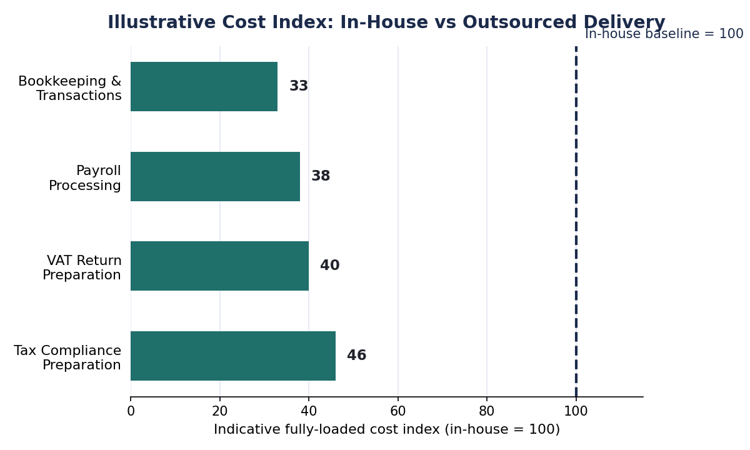
Indicative cost index based on typical UK market patterns. Model against your own cost base before publishing or presenting externally.
Step 5: Risk, Governance and Data Protection
Data protection is the section of an outsourcing checklist for UK accounting firms that most often gets rushed, and it is the one most likely to resurface later as a client complaint or an ICO enquiry. Two points matter more than any other. First, moving client data to a provider based outside the UK is a restricted transfer under UK GDPR unless it is covered by an adequacy regulation or another appropriate safeguard, so firms should expect to see a signed International Data Transfer Agreement or equivalent addendum in place, not a verbal assurance. Second, professional and regulatory expectations generally require firms to tell clients when their data is processed by a third party and, in many engagement letters, to obtain consent rather than rely on a buried clause. Firms that treat both points as a one-off legal sign-off, rather than an ongoing control, tend to be the ones caught out when a client asks a direct question mid-engagement.
Risk Area | Control | Review Frequency |
Cross-border data transfer | Signed transfer mechanism; encryption in transit and at rest | Annually, or on regulatory change |
Client disclosure & consent | Outsourcing clause built into engagement letters | At each engagement letter renewal |
Access control | Role-based access, MFA, logged file access | Quarterly access audit |
Confidentiality | Signed NDAs at firm and individual staff level | At onboarding and annually |
Service quality | Defined SLAs for turnaround time and accuracy | Monthly service review |
Exit & continuity | Data return and contract exit terms agreed upfront | At contract signing and renewal |
Step 6: The Implementation Roadmap
Even a well-chosen provider fails if the transition is rushed. The rollout below reflects a realistic pace for a mid-sized firm moving a single service line, typically bookkeeping or payroll, to an outsourced model. Multi-service transitions run longer.
Phase | Approx. Timing | Key Milestones |
Discovery & Scoping | Weeks 1–2 | Process mapping; data access requirements agreed |
Provider Onboarding | Weeks 3–4 | Systems access, NDAs and security checks completed |
Parallel Run | Weeks 5–8 | Provider and in-house team run the process side by side |
Full Transition | Weeks 9–10 | Provider takes primary responsibility; in-house reviews only |
30/60/90-Day Review | Weeks 11+ | Formal review against SLAs; scope adjusted if needed |
Step 7: Governing the Relationship After Go-Live
The checklist does not end at go-live. Firms that get lasting value from outsourcing run a short, standing governance rhythm: a monthly service review against agreed turnaround and accuracy metrics, a quarterly commercial review as client volumes shift under MTD, and an annual scope reset that asks, deliberately, whether the original split between retained and outsourced work still matches how the firm has grown. Treating this outsourcing checklist for UK accounting firms as a live governance tool, not a one-off implementation task, is what separates outsourcing relationships that compound in value from the ones that quietly underperform their original business case.
Frequently Asked Questions
Do UK accounting firms have to tell clients that work is being outsourced?
Generally, yes. Professional body guidance and most engagement letters expect firms to disclose when client data or work is handled by a third party, and UK GDPR requires a lawful basis and appropriate safeguards for that processing regardless of disclosure. Silence is not a defensible position if a client realises it later.
Is offshore outsourcing compliant with UK GDPR?
It can be, but compliance depends on the transfer mechanism, not the outsourcing decision itself. Transfers to a country without a UK adequacy decision need a recognised safeguard, such as the International Data Transfer Agreement, alongside genuine technical and organisational controls at the provider's end. Ask to see the signed transfer mechanism, not just a compliance statement.
Which accounting functions should never be fully outsourced?
Client relationship ownership, final professional judgement on tax positions, and sign-off responsibility should stay with the engagement partner regardless of how much preparation work is outsourced. Outsourcing the preparation of a VAT return is routine; outsourcing the decision of what to tell a client about their tax position is not.
How long does a typical outsourcing transition take?
For a single service line such as bookkeeping or payroll, a realistic timeline runs eight to twelve weeks from signed agreement to full transition, including a parallel run period. Multi-service transitions, or firms migrating practice management software at the same time, should plan for longer.
What certifications should an outsourcing partner hold?
At minimum, look for information security certification such as ISO 27001, a quality management standard such as ISO 9001, and, where relevant, recognised professional body employer status such as ACCA Approved Employer. None of these guarantee good work on their own, but their absence is a reasonable reason to keep looking.
How does Making Tax Digital for Income Tax change the outsourcing decision?
It changes the frequency of work, not just the volume. A client base moving from one annual return to four quarterly updates and a final declaration needs staffing that can flex every quarter, not just around the January deadline, which is exactly the kind of scalable, cyclical demand outsourced capacity is built to absorb.
Bringing the Checklist Together
None of these seven steps is complicated in isolation. Strategic readiness, function suitability, vendor due diligence, financial modelling, risk and governance, implementation, and ongoing review are things most Partners already do informally for other decisions. What changes the outcome is treating them as one connected outsourcing checklist for UK accounting firms rather than seven separate conversations spread across a year, because a provider that passes the due diligence table but fails the governance rhythm will eventually cost more than one that was never engaged at all. Firms working through this for the first time, from reading a certification correctly to modelling quarterly MTD capacity are welcome to run it past Virtual Clone's team rather than starting from a blank page.


Comments